
How Retatrutide’s Glucagon Activity Influences Lipolysis
Think of your body as a house with a storage room.
That room holds extra energy. Your fat cells are the storage boxes. When your body needs fuel, it can open those boxes and use what is inside.
One of the signals that helps with this is a hormone called glucagon.
Now, where does retatrutide fit in?
Retatrutide is an experimental drug being studied for weight loss. It works on three hormone receptors: GLP-1, GIP, and glucagon.
GLP-1 and GIP mainly affect hunger, fullness, and blood sugar. Glucagon has a different job. It helps your body access and use stored energy.
This is where lipolysis enters the story.
Lipolysis is simply the process of breaking down stored fat. It turns the fat inside your cells into fatty acids that your body can use for fuel.
So when retatrutide activates the glucagon receptor, what happens to those fat stores?
Could this signal help the body release more stored fat?
That question is at the heart of retatrutide’s glucagon activity. To understand it, we first need to look at how glucagon normally tells the body to use stored fat.
What Is Lipolysis?

So what is lipolysis? Lipolysis is the process your body uses to break down stored fat. Your fat cells store energy in the form of triglycerides. When your body needs energy, it breaks down the triglycerides into fatty acids and glycerol. These can then be used for energy.
This happens all the time, not just when you exercise or fast. Your body is constantly. Releasing fat in small amounts. If you eat a meal, your body stores fat. If you skip a meal or exercise, your body releases fat.
Several hormones control lipolysis. Glucagon is one of them. Adrenaline is another. Insulin does the opposite, telling your body to store fat.
The balance between these signals decides whether your body holds onto fat or releases it. This balance is where retatrutide’s glucagon activity comes in.
What Is Retatrutide?
Retatrutide is a peptide getting a lot of attention in research circles right now.
It’s built to act on three different receptors at once: GLP-1, GIP, and glucagon. Most peptides, like semaglutide or tirzepatide, stick to one or two. Retatrutide goes for all three. That’s what sets it apart.
Researchers often call it a triple agonist because of this. Each receptor plays its own role in how your body handles hunger, blood sugar, and fat. Retatrutide works on several systems that all feed into how your body stores and burns fat.
Right now, retatrutide is still in clinical trials. It hasn’t been approved for weight loss or any other use. But the early data has caught the interest of researchers and companies studying metabolic health. The reason is mainly because of the added glucagon piece. It’s the part most other peptides in its class don’t touch.
Retatrutide and Lipolysis: What Is the Connection?
Retatrutide activates glucagon receptors. Glucagon tells your body to break down stored fat. So when retatrutide turns on that receptor, it pushes fat cells to release energy instead of holding onto it.
Most weight loss peptides don’t work this way. GLP-1 mostly affects hunger and blood sugar. It doesn’t do much to trigger fat breakdown on its own. Retatrutide adds a second path. This one works directly on fat cells, not just on appetite.
So this isn’t just a link researchers noticed in trial data. There’s a clear mechanism behind it. Glucagon receptor activity sends a direct signal to your fat tissue: release fat, don’t store it. That signal has nothing to do with appetite. It’s a separate effect, and it’s a big reason retatrutide stands out from other peptides in its class.
How Does Retatrutide Work in the Body?
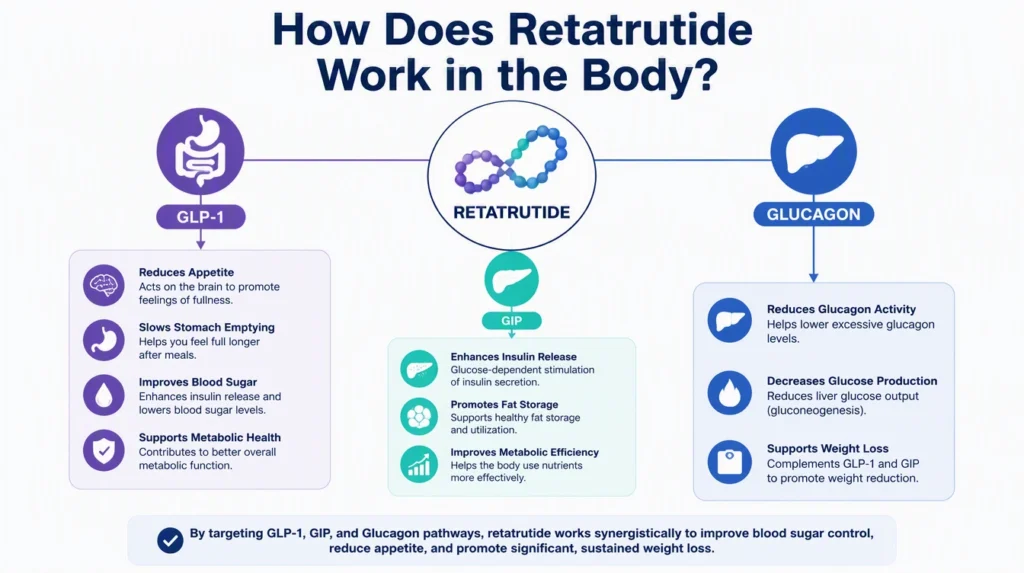
You already know retatrutide hits three receptors instead of one. Here’s what each one actually does once it’s activated.
GLP-1 Receptor Activity
This receptor slows down how fast food leaves your stomach and prompts your pancreas to release more insulin when blood sugar rises. The result is you stay full longer and your blood sugar stays steadier after meals.
GIP Receptor Activity
GIP works alongside GLP-1 rather than replacing it. It supports insulin release too, but it also helps your body use glucose more efficiently once it’s in your bloodstream. Tirzepatide already pairs these two receptors, and that combination outperforms GLP-1 alone in trials.
Glucagon Receptor Activity
Glucagon works on energy and fat storage rather than appetite or digestion. It’s the piece we’ll unpack in the next section, since it’s the one most directly tied to lipolysis.
How Does Glucagon Receptor Agonism Affect Lipolysis?
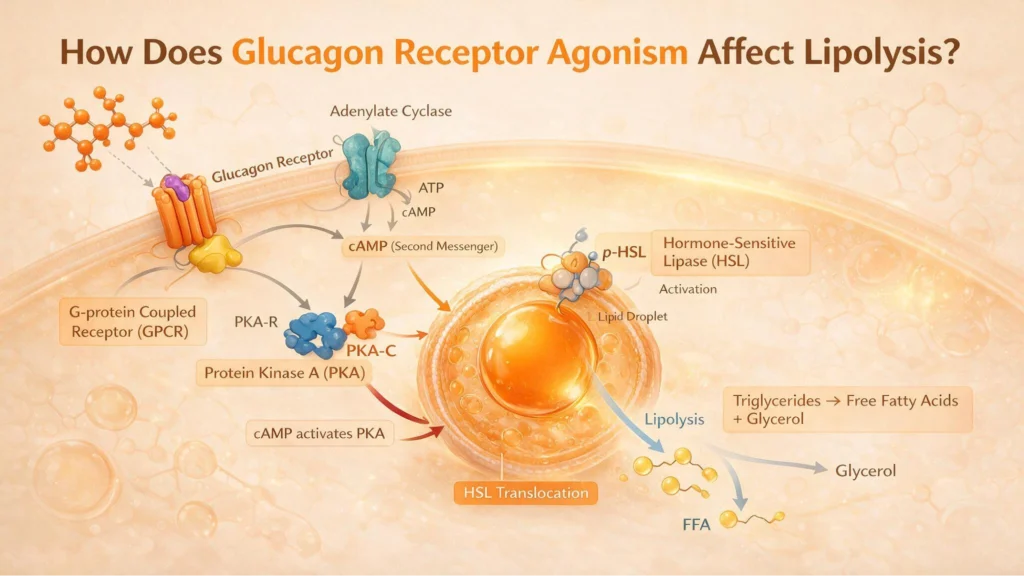
Now let’s get into the mechanism itself. This is the part that explains why retatrutide’s fat loss numbers look different from other medications in its class.
Glucagon Signaling and Fat Breakdown
When glucagon binds to its receptor on a fat cell, it sets off a chain reaction inside that cell. This activates an enzyme called hormone-sensitive lipase. That enzyme is the one that actually breaks triglycerides apart into fatty acids and glycerol. Without it, lipolysis doesn’t happen, no matter how much fat you have stored.
So when retatrutide activates glucagon receptors, it’s flipping on this same switch. The signal tells fat cells to start releasing their stored energy instead of holding onto it.
Effects on Stored Fat
Over time, this signal adds up. Fat cells that keep getting this “release” signal end up smaller, since they’re constantly giving up stored triglycerides rather than adding to them. That’s different from how GLP-1 works on its own, since GLP-1 mainly reduces how much you eat rather than directly telling your fat cells to release what’s already stored.
This doesn’t mean glucagon activity works in isolation. It works alongside the appetite and blood sugar effects from GLP-1 and GIP. But it does add a mechanism that’s specific to fat tissue itself, one that’s largely absent in medications that only target GLP-1.
Does Retatrutide Increase Lipolysis in Adipose Tissue?
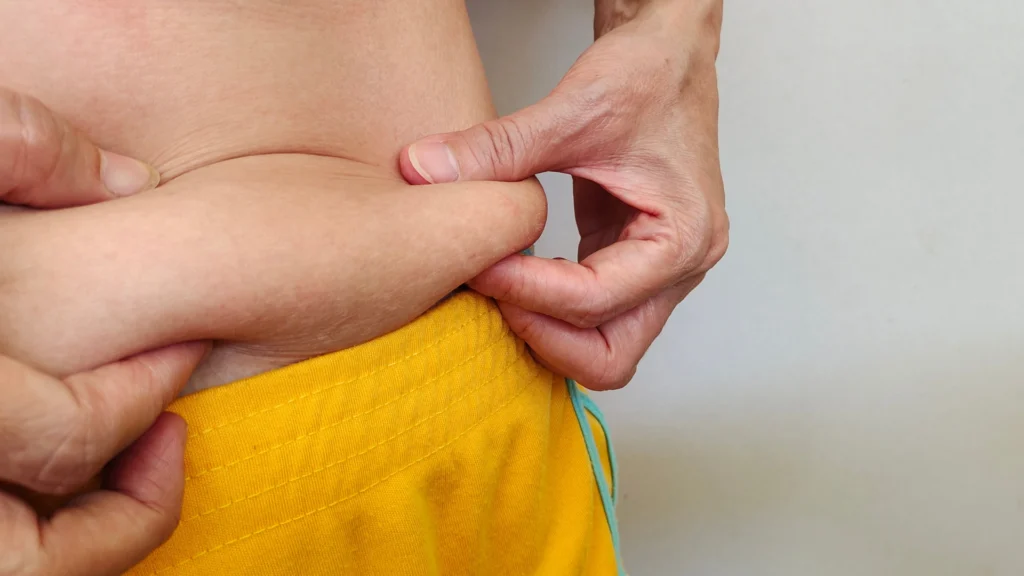
The short answer is yes, at least based on how the mechanism works. Retatrutide activates glucagon receptors, and those receptors sit directly on your fat cells. So the effect isn’t indirect. It’s happening right where the fat is stored.
Fat Mobilization From Adipocytes
Adipocytes are just fat cells. When glucagon receptors on these cells get activated, the cells start breaking down the fat they’re holding onto.
Think of it like a storage unit that suddenly starts handing out its contents instead of holding onto them. That’s fat mobilization. It’s the first step in getting stored fat out and into your bloodstream where your body can actually use it.
Release of Fatty Acids
Once a fat cell breaks down triglycerides, it releases fatty acids and glycerol into your blood. From there, other tissues, like your muscles and liver, can pick them up and burn them for energy. This is the actual moment fat leaves storage and becomes fuel.
So the process works like this:
- Retatrutide activates glucagon receptors.
- Those receptors trigger fat cells to break down stored triglycerides.
- The fatty acids get released into your blood for your body to use.
Releasing fatty acids is only half the story, though. What actually happens to them next, whether they get burned for fuel or end up back in storage, depends on your body’s energy needs at that moment.
How Does Retatrutide Affect Energy Expenditure and Fat Oxidation?

Getting fat out of storage is only step one. It still has to get used, or it just ends up back where it started.
Here’s how it works.
Retatrutide and Energy Expenditure
Energy expenditure is how many calories your body burns just to function. Not from a workout. From breathing, digesting food, keeping your organs running, all of it.
Glucagon plays a real role here. It can push your body to burn more calories at rest, without you doing anything extra. Early research on retatrutide points to this same effect. That matters, because most weight loss medications skip this step entirely. They lower your appetite and stop there.
Retatrutide and Fat Oxidation
Fat oxidation is a different process from lipolysis, even though people often use the terms interchangeably. Lipolysis breaks fat down and releases it into your bloodstream. Fat oxidation is your body actually burning that fat for energy.
Releasing fat doesn’t guarantee it gets used. If your body doesn’t burn it, those fatty acids can circulate and get stored right back in your fat cells. Glucagon receptor activity may help shift your body toward burning fat instead of sugar for fuel, which is what makes fat oxidation happen.
Lipolysis vs. Fat Oxidation
Breaking down fat is not the same as burning it.
Think of lipolysis as opening the storage room. It breaks stored fat into fatty acids and releases them into the bloodstream.
Fat oxidation comes next. It is when your body takes those fatty acids and uses them for energy.
So, one process releases the fuel. The other uses it.
Here’s how the two compare:
| Lipolysis | Fat Oxidation | |
| What it does | Breaks down stored fat | Burns fat for energy |
| Where it happens | Inside fat cells | Inside muscles, liver, and other tissues |
| What it releases | Fatty acids into the blood | Usable energy |
| Guarantees fat loss on its own? | No | Yes |
Both steps have to happen for fat loss to stick. Retatrutide’s glucagon activity appears to support each one, which may explain why its results in trials have outpaced other medications in this class.
How Does Retatrutide Affect Fat Metabolism in the Liver?
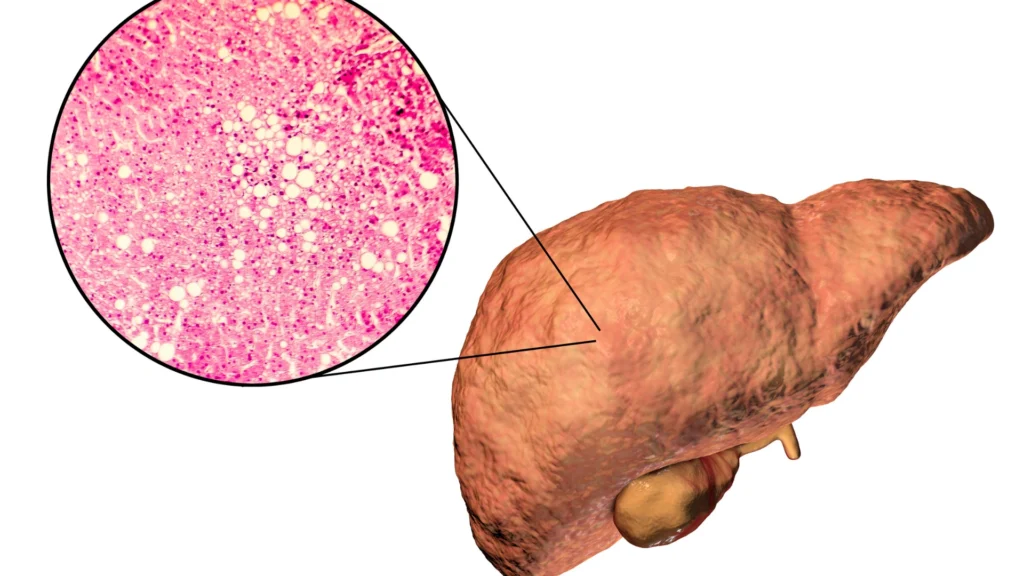
Your liver stores fat too, not just your fat cells. This matters because excess fat in the liver is linked to a condition called MASLD, which stands for metabolic dysfunction-associated steatotic liver disease. It’s common in people with obesity.
Glucagon receptor activity affects the liver directly. It can reduce how much fat the liver stores and support the breakdown of fat that’s already built up there. Retatrutide’s early trial data backs this up. Participants studied for liver-related outcomes showed improvements alongside their weight loss, not just from losing weight in general, but tied specifically to how the medication works on fat metabolism.
This is a separate benefit from what happens in your fat tissue. Your liver and your fat cells store fat differently and respond to signals differently. Glucagon receptor agonism appears to help with both, which is part of why researchers are studying retatrutide for liver disease as its own treatment target, not just as a side effect of weight loss.
Retatrutide and Appetite Suppression
Appetite suppression comes mostly from the GLP-1 and GIP receptors, not glucagon. These receptors slow digestion and increase feelings of fullness after meals. That’s why people on retatrutide tend to eat less without having to think about it constantly.
Glucagon receptor activity doesn’t work the same way. It doesn’t touch hunger signals directly. Instead, it works on energy expenditure and fat breakdown, the mechanisms covered in the last few sections.
So the appetite drop and the fat breakdown are two separate effects, running through two separate pathways. One reduces how much you eat. The other changes how your body handles the fat you already have. Together, they cover more ground than a single-pathway medication can.
Does Increased Lipolysis Lead to More Body Fat Loss?
Not automatically. More lipolysis means more fat gets released from storage. It doesn’t mean that fat is gone for good. If it’s not burned through fat oxidation or used for energy, it can end up back in your fat cells.
This is why the full picture matters more than any single mechanism. Retatrutide’s glucagon activity increases lipolysis, but it also appears to boost energy expenditure and shift the body toward burning fat instead of sugar. Those pieces working together are what likely drive the fat loss seen in trials, not lipolysis on its own.
What Does Current Research Say About Retatrutide and Fat Loss?

The research so far comes from Phase 3 clinical trials, and the results have been strong. Retatrutide is still investigational. It hasn’t been approved by the FDA, and it’s only available to people enrolled in clinical trials.
What Clinical Trials Have Found
The TRIUMPH trial program has tested retatrutide across different groups. Here’s what stands out:
- In TRIUMPH-1, adults with obesity or overweight who took the 12 mg dose lost an average of 70.3 lbs, or 28.3% of their body weight, over 80 weeks. Nearly half of them lost 30% or more, a level usually seen only with bariatric surgery.
- In TRIUMPH-2, adults with type 2 diabetes lost up to 49.6 lbs, or 20.8% of body weight, at the 12 mg dose over the same period. Weight loss tends to run lower in this group, which is expected.
- In TRIUMPH-3, adults with severe obesity and heart disease lost up to 55.8 lbs, or 22.6% of body weight, at 12 mg. This group also saw drops in triglycerides, cholesterol, and blood pressure.
These numbers are higher than what’s typically reported for other medications in this class, which target fewer receptors.
What We Still Don’t Know About Retatrutide and Lipolysis
There’s still a lot researchers haven’t nailed down. Most of what’s known about glucagon’s role in lipolysis comes from broader metabolic research, not studies isolating that one mechanism in retatrutide specifically. It’s hard to say exactly how much of the weight loss comes from lipolysis versus appetite suppression versus energy expenditure, since all three happen at once.
Long-term safety is also still being studied. Retatrutide hasn’t completed the full approval process, so questions about what happens with years of use, not just months, remain open. Until more targeted research comes out, a lot of what’s said about glucagon and lipolysis in this medication is still considered a strong mechanism, not a fully proven one.
Support Healthy Lipolysis Alongside Retatrutide
Retatrutide’s glucagon activity gives your body a real mechanism for breaking down fat and using it for energy.
But how well that mechanism plays out still depends on the basics: how you move, eat, sleep, and manage stress day to day. The medication does its part. The rest still falls on you.

If you’re working on your body composition goals in the meantime, you don’t have to figure it all out alone. At The Beauty Lounge Toronto, our team can help you build a plan around what actually supports fat metabolism, from body contouring treatments to guidance tailored to your goals.
Reach out to book a consultation and talk through what might work best for you right now.
FAQs
No. Retatrutide is still investigational and hasn’t been approved by the FDA. It’s only available to people enrolled in clinical trials. Phase 3 trials have shown strong results, and Lilly plans to file for approval in early 2027. Until then, it can’t be prescribed or purchased legally.
Semaglutide targets one receptor, GLP-1. Tirzepatide targets two, GLP-1 and GIP. Retatrutide targets three: GLP-1, GIP, and glucagon. That third receptor, glucagon, is what sets it apart. It’s tied to fat breakdown and energy use, not just appetite and blood sugar control.
Retatrutide has a long half-life, which is why it’s dosed just once a week. Its effects build up gradually over weeks as the dose increases in steps. Long-term data is still limited since the drug remains in clinical trials and hasn’t completed the full approval process yet.
The most reported side effects are gastrointestinal: nausea, diarrhea, vomiting, and constipation. Most cases were mild to moderate and eased with time. A smaller number of people stopped treatment because of these effects. Long-term safety is still being studied, since retatrutide hasn’t been fully approved yet.
This is still being studied. Like other medications in its class, some muscle loss can happen alongside fat loss. Pairing treatment with enough protein and regular strength training may help preserve muscle. Researchers haven’t fully confirmed how much retatrutide’s mechanism affects muscle mass on its own.