
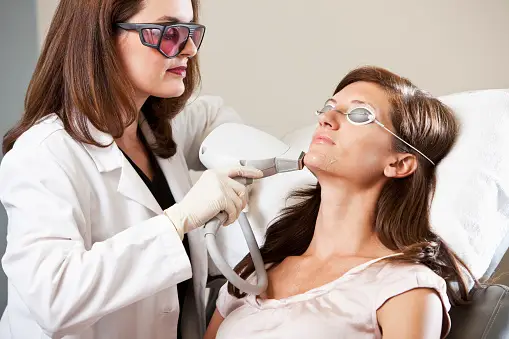
Laser hair removal treatment has gained more popularity than electrolysis for several reasons:
- Efficiency and Speed: Laser hair removal is generally faster and more efficient compared to electrolysis. With laser treatment, a wide area of hair can be targeted in a short amount of time, making it suitable for larger body areas. In contrast, electrolysis treats individual hair follicles one at a time, which can be time-consuming and may require multiple sessions.
- Treatment Time: Laser hair removal treatments typically require fewer sessions compared to electrolysis. While electrolysis often requires multiple visits to treat the same area, laser hair removal can achieve significant hair reduction in just a few sessions. This appeals to individuals seeking convenient and time-saving solutions.
- Reduced Discomfort: Laser hair removal is generally considered less painful compared to electrolysis. The laser emits a concentrated beam of light that targets the hair follicles, while electrolysis involves inserting a fine needle into each hair follicle, which can be more uncomfortable.
- Larger Treatment Areas: Laser hair removal is suitable for treating larger areas of the body, such as the legs, back, or chest. Electrolysis, on the other hand, is commonly used for smaller areas or individual hairs. This makes laser treatment a more practical option for individuals looking to remove hair from larger body surfaces.
- Precision and Effectiveness: Laser hair removal can selectively target dark, coarse hairs while sparing the surrounding skin, making it effective for people with different skin types and hair colors. Electrolysis, although effective for all hair and skin types, may require more expertise to achieve optimal results.
- Cost: While the initial cost of laser hair removal may be higher than electrolysis, the overall cost can be lower in the long run due to fewer sessions required. Electrolysis can involve ongoing maintenance treatments over an extended period, leading to higher cumulative costs.
It’s important to note that the popularity of hair removal methods can vary based on individual preferences, skin type, hair color, and desired outcomes. It’s advisable to consult with a professional or dermatologist to determine the most suitable hair removal treatment for your specific needs.

What is electrolysis?
Electrolysis is a method of permanent hair removal that involves the use of a fine probe or needle inserted into individual hair follicles. It is a process that targets each hair follicle individually, making it suitable for small areas or treating individual hairs.
During electrolysis, a small electric current is applied to the hair follicle through the probe. The current destroys the hair follicle’s growth cells, preventing further hair growth. This process is repeated for each hair follicle in the treated area.
There are three primary types of electrolysis:
- Galvanic Electrolysis: This method uses a direct current to create a chemical reaction within the hair follicle, which causes the production of lye (sodium hydroxide). The lye then destroys the hair follicle.
- Thermolysis: Also known as short-wave or high-frequency electrolysis, this method uses alternating current to generate heat within the hair follicle. The heat destroys the hair follicle.
- Blend Method: The blend method combines both galvanic electrolysis and thermolysis. It involves the simultaneous application of direct current and alternating current. This method is believed to be more effective than using either technique alone.
Electrolysis can be used on various parts of the body, including the face, eyebrows, bikini area, underarms, and legs. It is considered a safe and effective method for permanent hair removal. However, electrolysis can be time-consuming, especially for larger treatment areas, as each hair follicle needs to be treated individually. Multiple sessions are usually required to achieve the desired results.
Benefits of laser hair removal treatment over electrolysis:
Laser hair removal treatment offers several benefits over electrolysis:
- Speed and Efficiency: Laser hair removal is faster and more efficient compared to electrolysis. With laser treatment, a larger area of hair can be targeted in a shorter amount of time. This makes it a more convenient option, especially for individuals looking to treat larger body areas.
- Reduced Discomfort: Laser hair removal is generally considered less painful than electrolysis. The sensation during laser treatment is often described as a mild stinging or snapping feeling, whereas electrolysis can be more uncomfortable, as it involves inserting a needle into each hair follicle.
- Precision and Effectiveness: Laser hair removal can selectively target dark, coarse hairs while sparing the surrounding skin. This makes it effective for individuals with different skin types and hair colors. Electrolysis can be effective for all hair and skin types, but it may require more expertise to achieve optimal results.
- Treatment Time: Laser hair removal treatments typically require fewer sessions compared to electrolysis. Significant hair reduction can be achieved in just a few sessions, whereas electrolysis may require multiple visits to treat the same area. This saves time and effort for individuals seeking a quicker solution.
- Versatility: Laser hair removal can be used on larger treatment areas, such as the legs, back, or chest, making it suitable for both small and large body surfaces. Electrolysis is commonly used for smaller areas or individual hairs, limiting its applicability for larger areas.
- Cost: While the initial cost of laser hair removal may be higher than electrolysis, the overall cost can be lower in the long run. This is because laser treatment requires fewer sessions, whereas electrolysis may involve ongoing maintenance treatments over an extended period.
It’s important to consider that the effectiveness and experience of hair removal treatments can vary based on individual factors such as skin type, hair color, and desired outcomes. It’s advisable to consult with a professional or dermatologist to determine the most suitable hair removal treatment for your specific needs.
Why don’t more people do electrolysis?
Great question — electrolysis is a highly effective and permanent method of hair removal, yet it’s not nearly as popular as options like laser hair removal, shaving, or waxing. Here are the main reasons why more people don’t choose electrolysis:
1. Time-Consuming
-
Electrolysis treats one hair at a time, so sessions are much longer, especially for large areas like legs or backs.
-
It can take dozens to hundreds of sessions to complete full treatment, depending on the area.
2. Cost
-
While the per-session cost is often lower than laser hair removal, the cumulative cost adds up due to the number of sessions required.
-
In some cases, people pay thousands of dollars over the course of treatment.
3. Pain and Discomfort
-
Electrolysis can be more painful than laser hair removal, especially in sensitive areas.
-
Some describe it as a stinging or pricking sensation with each hair.
4. Slower Results
-
Results are gradual, especially because hair grows in cycles and only hairs in the active growth phase can be effectively treated.
5. Less Marketing and Awareness
-
Laser hair removal is heavily marketed, especially by med spas and cosmetic clinics.
-
Electrolysis doesn’t have the same visibility, so many people don’t even consider it as an option.
6. Convenience and Trend
-
Laser hair removal offers quicker results over fewer sessions, and is seen as more modern and high-tech.
-
Many people opt for the faster solution, even if it’s not truly permanent for all hair types.
7. Technician Availability
-
Electrolysis requires more skill and precision, so there are fewer trained practitioners, especially outside of large cities.
8. Skin and Hair Type Compatibility
-
Laser hair removal doesn’t work well on light or fine hair, whereas electrolysis works on all hair types and skin tones — but most people only turn to it when laser fails.
